
Flutesan 15 Pieces 2 Line Engineering Scientific Calculator Bulk Function Math Calculator Large Display for Student Teacher
- Sufficient Quantity: you will receive 15 packs of calculators for school, packs of school calculators.
- Practical Tools: the engineering calculator with 240 scientific functions can easily handle 1 and 2.
- 2 Line Clear Display: this math calculator has a 12 digit high definition display widescreen, and a 2 line.
- Easy to Hold: this scientific calculator engineering has a hard sliding cover that can protect the keys of.

New, Two Line Display, Desktop Calculator. History Function- 30 Memories, Calculator with Large LCD for Home & Office Use, 4.5×7
- If you press the key too fast, it can cause an error because TL-250 used IC for engineering calculators.
- Size: 4.5×7 inch, 153g, Two way power Two Line Display, Desktop Calculator
- History Function - The calculated record can be retrieved and corrected. ( About 30 memories )
- Turn the calculator upside down and remove the battery History will be deleted after three seconds.

Desk Calculator Large Display Big Buttons with 12 Digits 2-line LCD, Dual Solar Power and Battery Calculators with Tax and Check
- Two line display tax calculator can calculate VAT, simplify the tax computing process, and provide users.
- Calculators features a 120-step calculation history, making it easy to handle lengthy numerical.
- Desk calculator with 12-digit LCD big display can display two lines of information at the same time.
- Calculators is powered by solar and AAA batteries, it is not affected by power interruptions during use.
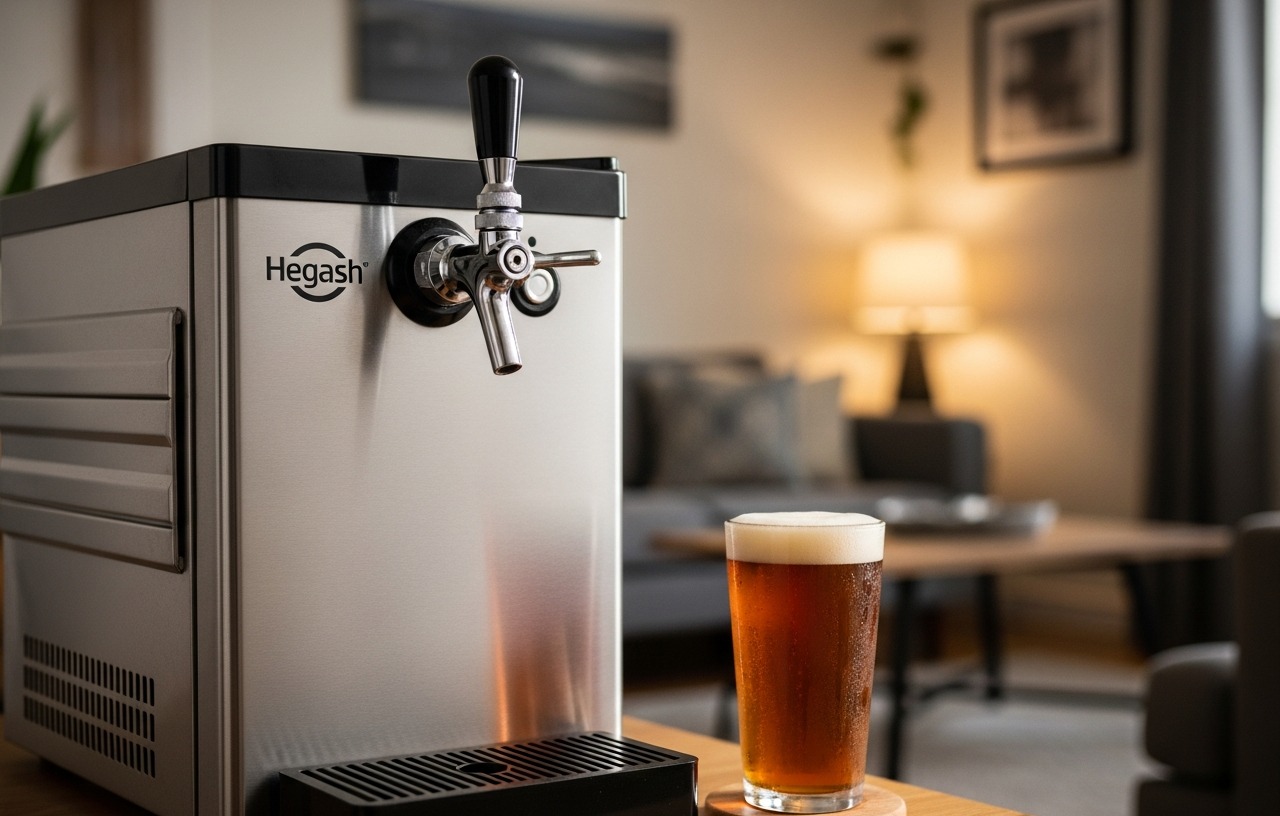
Flat beer, or beer that pours with excessive foam, indicates an imbalance in your kegerator's serving pressure. Achieving a perfectly carbonated pint requires careful attention to your CO2 regulator settings. Incorrect pressure leads to a poor pour and can negatively impact the flavor and aroma of your carefully crafted homebrew.
This guide provides a step by step approach to setting the serving pressure for your homebrew kegerator. It covers the essential tools, explains the science behind carbonation, and helps you troubleshoot common issues. By understanding these principles, you can enjoy your beer exactly as intended.
Why Correct Serving Pressure Matters for Homebrew
The CO2 pressure in your kegerator serves two primary functions. First, it maintains the desired carbonation level in your beer. Beer naturally contains dissolved carbon dioxide. When stored in a keg, CO2 pressure prevents the dissolved gas from escaping, keeping your beer from going flat. Second, the CO2 pressure pushes the beer from the keg through the beer lines and out of the tap. Without enough pressure, the beer will not pour properly. Too much pressure can lead to over-carbonation and excessive foam.
Different beer styles require different levels of carbonation. For example, a crisp German lager might need higher carbonation (around 2.5-2.7 volumes of CO2) compared to a traditional English ale (1.8-2.2 volumes). Matching your serving pressure to the beer style and temperature is key to a balanced pour and taste.
Essential Tools and Materials
Before you begin, gather these items:
- CO2 Tank: Filled and ready.
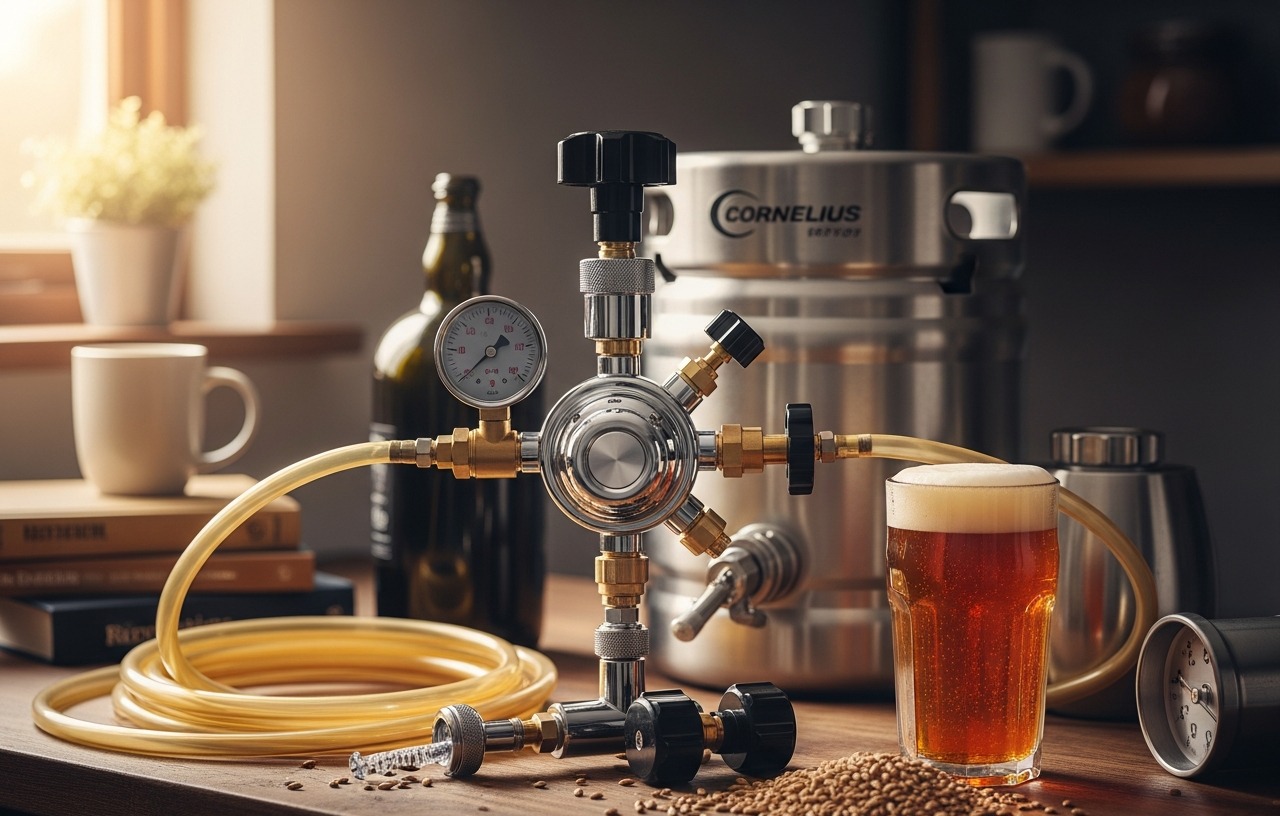
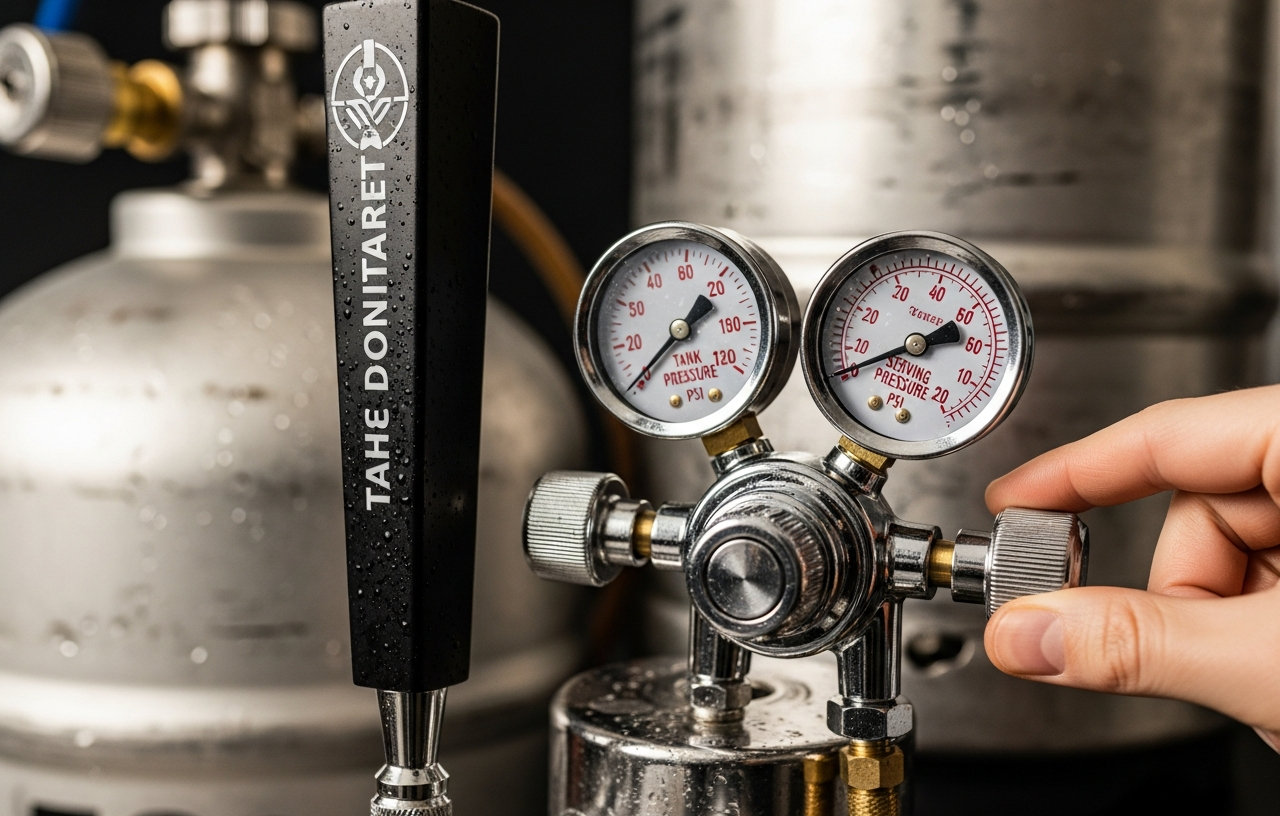
- CO2 Regulator: A dual-gauge regulator is highly recommended. One gauge shows the tank pressure, the other shows the serving pressure. If you are building one, our guide on Best Kegerator Conversion Kits can help.
- Carbonation Chart: This chart correlates beer temperature, desired volumes of CO2, and the corresponding PSI setting.
- Wrench: For tightening regulator connections.
- Leak Detector Spray (or Soapy Water): For checking connections.
- Scientific Calculator (Optional but helpful): For quick calculations. While carbonation charts are essential, a scientific calculator can help quickly process the variables, especially if you are adjusting for different beer styles or temperatures. The regulator is the control center for your CO2. It reduces the high pressure from the CO2 tank to a safe and usable serving pressure for your beer.
Key Factors for Setting Pressure
- Beer Temperature: This is the single most critical factor. Colder beer absorbs and holds more CO2 than warmer beer. Always measure the actual temperature of the beer inside the keg, not just the ambient air temperature of your kegerator.
- Desired Carbonation Level: Expressed in 'volumes of CO2'. This varies by beer style. Light lagers might be 2.5-2.7 volumes, while stouts could be 2.0-2.3 volumes. Know your beer style's target carbonation.
- Beer Line Length and Diameter: Longer and narrower lines create more resistance, allowing you to use slightly higher pressures without excessive foam. Typical homebrew setups use 5-10 feet of 3/16-inch ID (inner diameter) beer line. This length helps balance the pressure from the keg to the tap, ensuring a smooth pour.
Using a Carbonation Chart
A carbonation chart is your best friend for setting serving pressure. Find one online or in homebrewing literature. To use it, you need two pieces of information: the exact temperature of your beer (in degrees Fahrenheit or Celsius) and the desired volumes of CO2 for your beer style. Locate these values on the chart. The intersection will show the target PSI (pounds per square inch) for your regulator.
For example, if your beer is at 38°F (3.3°C) and you want 2.5 volumes of CO2, the chart might indicate a serving pressure of approximately 10-12 PSI. If you want to confirm your calculations, a scientific calculator can verify the chart's values or help interpolate between them. A Desk Calculator Large Display Big Buttons with 12 Digits 2-line LCD can also be useful for quick number checking during this process.
step by step: Setting Your Kegerator Serving Pressure
Follow these steps carefully to achieve optimal serving pressure for your homebrew.
Step 1: Determine Your Beer's Exact Temperature
Measure the temperature of your beer inside the keg. Do not rely solely on your kegerator's thermostat. A thermometer placed directly into a small sample of beer, or taped to the side of the keg (insulated), provides the most accurate reading. Allow the beer to reach its stable serving temperature, usually 24-48 hours after placing it in the kegerator.
Step 2: Identify the Desired Carbonation Level for Your Beer Style
Research the recommended volumes of CO2 for the specific beer style you are serving. For example:
- English Ales: 1.8-2.2 volumes
- American Ales/Lagera: 2.2-2.7 volumes
- German Lagers (Pilsner, Oktoberfest): 2.5-2.7 volumes
- Wheat Beers (Hefeweizen): 3.0-4.0 volumes (often higher)
- Stouts/Porters: 2.0-2.4 volumes
Choose a target within this range. Most brewers aim for the middle to slightly higher end of the range for a more lively beer.
Step 3: Consult a Carbonation Chart to Find Target PSI
Using your beer's temperature and desired volumes of CO2, find the corresponding PSI on a carbonation chart. This is the pressure you will set on your regulator.
Step 4: Connect the CO2 Regulator to the Tank
Make sure the CO2 tank valve is closed. Attach the regulator firmly to the CO2 tank using a wrench. Do not overtighten, but make sure the connection is snug to prevent leaks.
Step 5: Connect Gas Line to the Keg
Attach the gas quick disconnect to the gas post on your keg. You should hear a slight hiss as the connection is made. If you have multiple kegs, make sure each gas line is properly connected.
Step 6: Open CO2 Tank Valve and Set Initial Pressure
Slowly open the main valve on your CO2 tank. The high-pressure gauge on your regulator will show the tank's remaining pressure. Turn the adjustment knob on your regulator clockwise to increase the serving pressure. Set it to the target PSI you determined in Step 3. Then, turn the adjustment knob counter-clockwise slightly to relieve tension on the spring, preventing creep.
Step 7: Check for Leaks
This step is critical. Apply leak detector spray or soapy water to all connections: the CO2 tank to regulator, regulator to gas line, and gas line to keg post. If you see bubbles forming, you have a leak. Tighten the connection or replace O-rings as needed. Leaks can quickly empty your CO2 tank, leading to flat beer and wasted gas. For professional assistance, a service call for a kegerator repair can cost $80-$150, plus parts.
Step 8: Allow Time for Carbonation Equilibrium (If Force Carbonating)
If your beer is not yet fully carbonated, you will need to allow time for the CO2 to dissolve into the beer. This is known as force carbonation. Set your pressure to the target PSI and leave it for several days. A common method is 'set and forget,' where the keg is left at serving pressure for 5-7 days. Alternatively, you can use a higher pressure (e.g., 30 PSI) for 24 hours, then reduce it to serving pressure, but this risks over-carbonation. For this guide, assume the beer is already carbonated or you are using the 'set and forget' method.
Step 9: Purge the Keg's Headspace (Optional, but Recommended)
Once the pressure is set, lift the pressure relief valve on the keg several times to release any oxygen or excess CO2 from the headspace. This helps ensure consistent carbonation and removes any residual oxygen that might cause oxidation. Do this gently to avoid excessive foaming.
Step 10: Test Pour and Adjust as Needed
After allowing sufficient time for the beer to equilibrate (if newly carbonated), pour a small sample. Observe the pour speed, foam level, and taste. If the beer pours too slowly or is flat, slightly increase the pressure (1-2 PSI increments). If it pours too quickly or is excessively foamy, decrease the pressure. Make small adjustments and wait a few hours between changes for the system to stabilize.
Troubleshooting Common Serving Pressure Issues
Excessive Foam
This is a frequent complaint. Possible causes:
- Pressure too high: Reduce PSI by 1-2 increments.
- Beer too warm: Ensure your kegerator is maintaining the correct temperature.
- Short beer lines: If your lines are too short or wide, they do not provide enough resistance. Consider increasing line length to 8-10 feet of 3/16-inch ID line.
- Dirty beer lines or tap: Always keep your system clean.
- Quick disconnect issues: A faulty quick disconnect can introduce turbulence.
Flat Beer or No Foam
If your beer lacks carbonation or pours without a head:
- Pressure too low: Increase PSI by 1-2 increments.
- CO2 leak: Recheck all connections with soapy water. A slow leak can empty your tank without you noticing quickly.
- Empty CO2 tank: Check the high-pressure gauge on your regulator.
- Beer not carbonated: Allow more time for force carbonation at the correct pressure.
long term Maintenance for Consistent Pours
Regular maintenance ensures your kegerator continues to deliver perfect pints. Clean your beer lines every few kegs or at least every 4-6 weeks to prevent off-flavors and maintain proper flow. Periodically check your CO2 regulator for proper function and accuracy. Keep an eye on your CO2 tank levels so you do not run out mid-keg. It ensures your beer is presented at its best, with proper carbonation and a smooth, appealing pour. Take your time, use the carbonation chart, and make small, deliberate adjustments. Your patience will be rewarded with a perfect pint every time.
Our Recommendation🏆 TOP PICK
Flutesan 15 Pieces 2 Line Engineering Scientific Calculator Bulk Function Math Calculator Large Display for Student Teacher
Check Price on Amazon- Sufficient Quantity: you will receive 15 packs of calculators for school, packs of school calculators.
- Practical Tools: the engineering calculator with 240 scientific functions can easily handle 1 and 2.
- 2 Line Clear Display: this math calculator has a 12 digit high definition display widescreen, and a 2 line.
- Easy to Hold: this scientific calculator engineering has a hard sliding cover that can protect the keys of.
New, Two Line Display, Desktop Calculator. History Function- 30 Memories, Calculator with Large LCD for Home & Office Use, 4.5×7
Check Price on Amazon- If you press the key too fast, it can cause an error because TL-250 used IC for engineering calculators.
- Size: 4.5×7 inch, 153g, Two way power Two Line Display, Desktop Calculator
- History Function - The calculated record can be retrieved and corrected. ( About 30 memories )
- Turn the calculator upside down and remove the battery History will be deleted after three seconds.
Desk Calculator Large Display Big Buttons with 12 Digits 2-line LCD, Dual Solar Power and Battery Calculators with Tax and Check
Check Price on Amazon- Two line display tax calculator can calculate VAT, simplify the tax computing process, and provide users.
- Calculators features a 120-step calculation history, making it easy to handle lengthy numerical.
- Desk calculator with 12-digit LCD big display can display two lines of information at the same time.
- Calculators is powered by solar and AAA batteries, it is not affected by power interruptions during use.