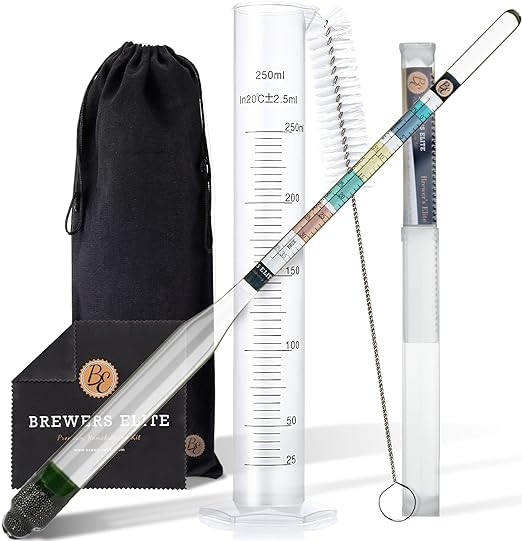
Brewer's Elite Hydrometer & Plastic Test Jar - for Home Brew Beer, Wine, Mead and Kombucha - Deluxe Triple Scale Set, Hardcase
- Lab Tested Unrivalled Quality & Accuracy - All Brewer's Elite Hydrometers are rigorously tested to.
- 75+ Brewing Video Courses & Tutorials!: Due to our exclusive partnership with Craft Beer & Brewing.
- Everything you need: This kit contains everything you need to get started on your journey to measuring.
- Precision Made Simple: The easy-to-read color scale and specially designed font allow for clear.

BACtrack S80 Breathalyzer | Professional-Grade Accuracy | DOT & NHTSA Approved | FDA 510(k) Cleared | Portable Breath Alcohol
- #1-RATED BREATHALYZER BY WIRECUTTER - "After 65 hours of research, which included getting intoxicated at a.
- PROFESSIONAL-GRADE ACCURACY - Powered by BACtrack's largest platinum-based Xtend Fuel Cell Sensor, the S80.
- SIMPLE, ONE-BUTTON OPERATION - The BACtrack S80 is extremely easy to use. Simply insert the two included.
- DOT/NHTSA APPROVED & FDA 510(k) CLEARED - Designated by the US DOT & NHTSA as an approved breath alcohol.

Hydrometer - Alcohol, 0-200 Proof and Tralle
- The proof scale has a range of 0-200 (0-100%ABV) with a 0-200 percent scale for proof of spirit scale. The.
- The alcohol meter can be used as an Alcohol tester for liquor, moonshine, corn whiskey, or other high.
- Easy and accurate readings help you along the brewing progress. Use our alcohol hydrometer to make.
- FastRack Alcohol hydrometers are manufactured in the USA; You can expect durability and consistent quality.
Measuring the specific gravity of your fermenting beverages is critical for understanding fermentation progress and calculating alcohol content. A homebrew hydrometer is the standard tool for this task. Without one, you are essentially guessing at how your beer, wine, mead, or kombucha is developing. This guide will help you select the best hydrometer and understand how to use it properly.
What is a Homebrew Hydrometer and Why Do You Need One?
A hydrometer is a scientific instrument used to measure the specific gravity of a liquid. In homebrewing, it measures the density of your wort (unfermented sugary liquid) or mead/wine must. As yeast consumes sugars during fermentation, it converts them into alcohol and carbon dioxide. This process reduces the sugar content in the liquid, making it less dense. The hydrometer sinks lower in a less dense liquid and floats higher in a denser liquid.
By taking readings at different stages, you can:
- Determine the Original Gravity (OG) before fermentation begins.
- Track the progress of fermentation by measuring gravity over time.
- Determine when fermentation is complete by observing stable, low gravity readings.
- Calculate the Alcohol By Volume (ABV) of your finished beverage.
For anyone serious about homebrewing or fermenting other beverages like kombucha or wine, a hydrometer is a non-negotiable piece of equipment. If you are just starting, consider looking into beginner starter kits that often include basic hydrometers.
Types of Hydrometers and What They Measure
Hydrometers come in various forms, but the most common for homebrewing are triple-scale hydrometers. Water has an SG of 1.000. Wort typically starts between 1.030 and 1.060, and ferments down to 1.000 or slightly below.
The Brewer's Elite Hydrometer & Plastic Test Jar is a highly-rated option that includes these three scales. It's often recommended for its accuracy and comes with a protective case. Its makers claim it is lab-tested for quality. This kit provides everything needed to start measuring, including a plastic test jar suitable for most homebrew batches.
Single-Scale Hydrometers
Less common for general homebrewing, single-scale hydrometers might focus only on Specific Gravity, or specialized scales like Proof (for spirits) or Balling (similar to Brix). The Hydrometer - Alcohol, 0-200 Proof and Tralle, for example, is designed for measuring alcohol content in spirits, with a range of 0-200 proof (0-100% ABV). The scale range is also important.
Accuracy and Calibration
Look for hydrometers that are individually calibrated or have a stated accuracy of plus or minus 0.001 SG units. Higher quality instruments will have more precise markings and a more stable floatation point. Some manufacturers provide calibration certificates or mention rigorous testing, which adds confidence in their product's reliability.
Scale Range
For most beers and ales, a hydrometer with a specific gravity range of 0.990 to 1.100 is sufficient. This covers most starting gravities and the typical range after fermentation. For high-gravity beers, wines, or meads, you might need a wider range. The Brewer's Elite hydrometer covers 0.990 to 1.060 on the SG scale, which is adequate for most common homebrews.
Readability
The markings on the hydrometer should be clear and easy to read. Fine lines and clear numbers prevent misinterpretation. The stem should be thin enough to allow for precise readings at the liquid's surface.
Material and Durability
Most hydrometers are made of glass. While fragile, glass is inert and won't react with your wort. It's essential to handle them with extreme care. A protective case, like the one included with the Brewer's Elite kit, is a significant advantage for storage and transport.
Test Jar
Your hydrometer needs a container to float in. A dedicated test jar is usually a tall, narrow cylinder made of glass or plastic. Plastic test jars are less prone to breaking than glass ones, making them a safer choice for many homebrewers. Some kits, like the Brewer's Elite, include a suitable test jar.
How to Use a Homebrew Hydrometer Correctly
Proper technique is vital for obtaining accurate specific gravity readings. Follow these steps:
- Sanitize Everything: Before taking any sample, thoroughly sanitize your hydrometer, test jar, and any transfer equipment. This prevents introducing unwanted microbes into your fermenter. Refer to guides on how to sanitize brewing equipment for best practices.
- Collect a Sample: Carefully siphon or pour a sample of your wort or must into the sanitized test jar. Ensure you collect enough liquid for the hydrometer to float freely. Avoid introducing excessive oxygen, especially if you are taking a sample before fermentation is complete.
- Remove Bubbles: Gently swirl the test jar to dislodge any air bubbles clinging to the hydrometer or the liquid's surface. Bubbles can affect the reading.
- Insert the Hydrometer: Slowly lower the sanitized hydrometer into the liquid. Do not drop it, as this can cause it to stick or break.
- Take the Reading: Allow the hydrometer to float freely. Read the specific gravity at the bottom of the meniscus (the curve of the liquid surface). Ensure you are reading at eye level to avoid parallax error.
- Record the Reading: Note the specific gravity, date, and time in your brewing log. Avoid using soap, as residue can affect future readings. Store the hydrometer in its protective case.
Temperature Correction
Hydrometers are calibrated to be accurate at a specific temperature, usually 60°F (15.6°C) or 68°F (20°C). If your sample is warmer or cooler than the calibration temperature, your reading will be slightly off. Most hydrometers come with a temperature correction chart, or you can find one online. For example, if your hydrometer is calibrated to 60°F and your sample is at 70°F, you will need to add a small amount to your reading. Small temperature variations (a few degrees) often have a minimal impact on common homebrew ranges, but it's good practice to be aware of it.
Red Flags to Watch For
When shopping for a hydrometer, be aware of potential issues:
- Inconsistent Readings: If you take multiple readings of the same sample and get significantly different results, the hydrometer might be faulty or not properly calibrated.
- Cloudy or Unclear Markings: Difficult-to-read scales make accurate measurements impossible.
- Chipped or Cracked Glass: A damaged hydrometer is unsafe to use and can give inaccurate readings. Discard it immediately.
- Floating Too High or Too Low: If the hydrometer consistently floats in an unexpected position for a known liquid (like plain water, which should read 1.000), it may be damaged or miscalibrated.
- No Test Jar Included: While not a defect, many users prefer to buy a kit that includes a test jar for convenience and to ensure compatibility.
long term Cost of Ownership and Maintenance
A good quality hydrometer is a one-time purchase that can last for many years with proper care. The initial cost for a reliable triple-scale hydrometer and test jar set typically ranges from $20 to $40. Cheaper options exist, but they often sacrifice accuracy and durability.
Maintenance is minimal:
- Cleaning: Always rinse your hydrometer and test jar with clean water immediately after use. Avoid harsh chemicals or abrasive cleaners that could damage the glass or alter the hydrometer's calibration.
- Storage: Store your hydrometer in its protective case, away from extreme temperatures and potential damage.
- Calibration Checks: Periodically check your hydrometer's accuracy by measuring the specific gravity of distilled water (which should be 1.000 at 60°F or 15.6°C). If it's consistently off, it may be time for a replacement.
The cost of ownership is low, primarily involving the initial purchase and the minimal effort of cleaning and careful storage. Considering the value it provides in controlling and understanding your fermentation, it's an economical tool for any brewer.
Comparing Hydrometer Options
When comparing hydrometers, consider the following:
- Reviews: Look for products with consistently high user ratings and positive reviews focusing on accuracy and ease of use.
- Included Accessories: Does it come with a test jar? A protective case? These add value.
- Scale Type: Ensure it has the scales you need (SG, PA, Brix).
- Brand Reputation: Established homebrewing brands often offer more reliable products.
The Brewer's Elite Hydrometer & Plastic Test Jar stands out due to its comprehensive features, included accessories, and positive user feedback regarding its accuracy. It offers a complete package for beginners and experienced brewers alike, providing the essential tools to measure fermentation progress effectively. Its partnership with Craft Beer & Brewing for video courses also adds significant educational value for those looking to improve their skills.
Conclusion
A hydrometer is an indispensable tool for any homebrewer or fermentation enthusiast. It provides objective data on your brew's development, allowing for consistent results and a deeper understanding of the fermentation process. By understanding the different types, key specifications, and proper usage, you can select a hydrometer that meets your needs and reliably guides you from wort to finished beverage. Investing in a quality instrument like the Brewer's Elite hydrometer will pay dividends in brewing confidence and quality.
Frequently Asked Questions
What is the ideal temperature for taking a hydrometer reading?
The ideal temperature is the calibration temperature of your hydrometer, which is usually 60°F (15.6°C) or 68°F (20°C). If your sample is at a different temperature, use a temperature correction chart to adjust your reading for accuracy.
Can I use a hydrometer for kombucha or wine?
Yes, hydrometers are excellent for monitoring the fermentation of kombucha, wine, mead, and cider. For wine and mead, the Brix scale is also very useful for measuring sugar content. For kombucha, while less common, it can help track the conversion of sugar to alcohol and acid.
My hydrometer reading is not 1.000 for plain water. What should I do?
If your hydrometer does not read 1.000 in distilled water at the calibration temperature, it is likely miscalibrated or damaged. While you can try to apply a correction factor, it is generally best to replace a faulty hydrometer to ensure accurate brewing results.
Brewer's Elite Hydrometer & Plastic Test Jar - for Home Brew Beer, Wine, Mead and Kombucha - Deluxe Triple Scale Set, Hardcase
- Lab Tested Unrivalled Quality & Accuracy - All Brewer's Elite Hydrometers are rigorously tested to.
- 75+ Brewing Video Courses & Tutorials!: Due to our exclusive partnership with Craft Beer & Brewing.
- Everything you need: This kit contains everything you need to get started on your journey to measuring.
- Precision Made Simple: The easy-to-read color scale and specially designed font allow for clear.
BACtrack S80 Breathalyzer | Professional-Grade Accuracy | DOT & NHTSA Approved | FDA 510(k) Cleared | Portable Breath Alcohol
- #1-RATED BREATHALYZER BY WIRECUTTER - "After 65 hours of research, which included getting intoxicated at a.
- PROFESSIONAL-GRADE ACCURACY - Powered by BACtrack's largest platinum-based Xtend Fuel Cell Sensor, the S80.
- SIMPLE, ONE-BUTTON OPERATION - The BACtrack S80 is extremely easy to use. Simply insert the two included.
- DOT/NHTSA APPROVED & FDA 510(k) CLEARED - Designated by the US DOT & NHTSA as an approved breath alcohol.
Hydrometer - Alcohol, 0-200 Proof and Tralle
- The proof scale has a range of 0-200 (0-100%ABV) with a 0-200 percent scale for proof of spirit scale. The.
- The alcohol meter can be used as an Alcohol tester for liquor, moonshine, corn whiskey, or other high.
- Easy and accurate readings help you along the brewing progress. Use our alcohol hydrometer to make.
- FastRack Alcohol hydrometers are manufactured in the USA; You can expect durability and consistent quality.